Story
Six Graduate Students
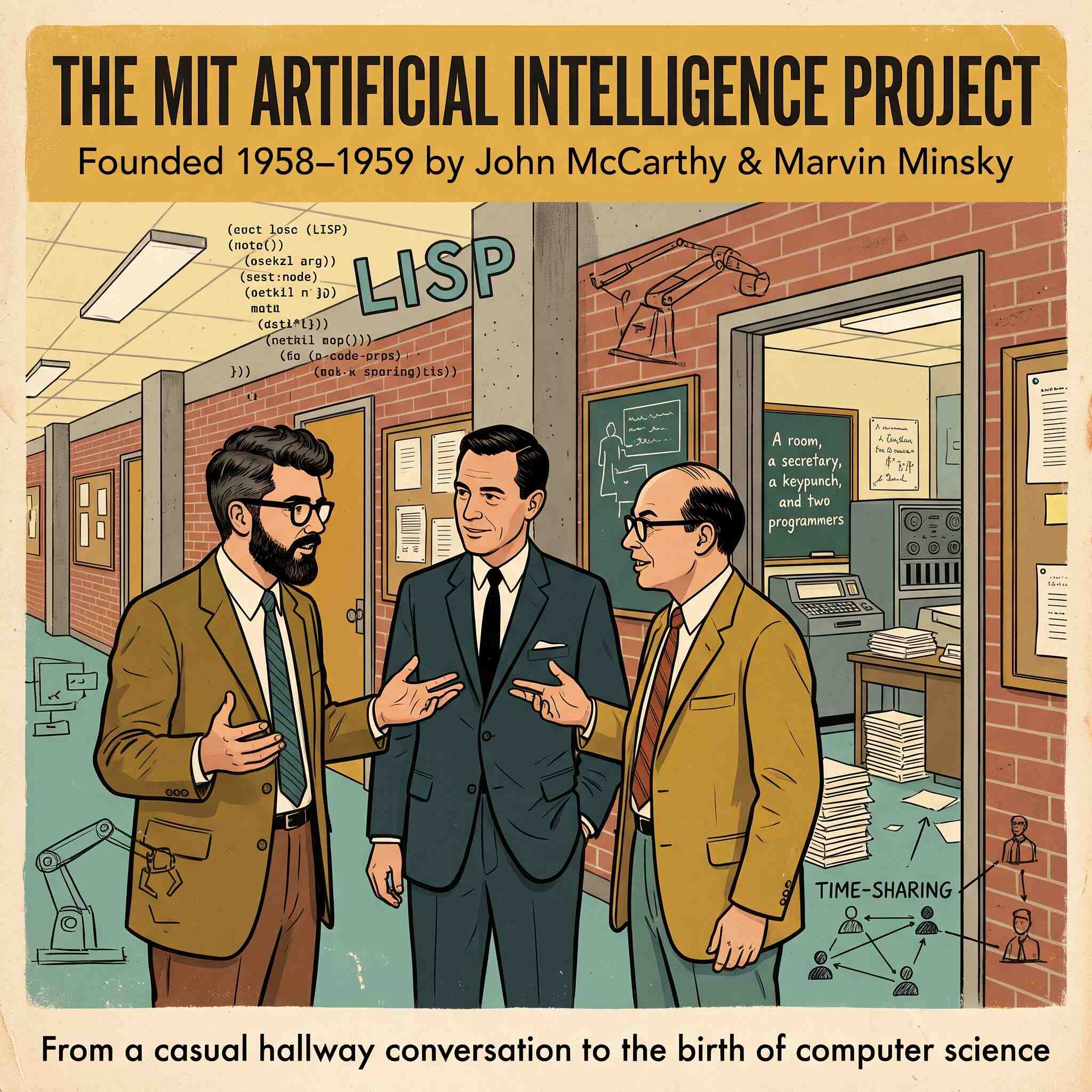
"A room, a secretary, a keypunch and two programmers."
Building 20 was supposed to come down after the war. MIT had put it up in 1943 out of plywood, asbestos and the assumption that nobody would need it for long. Fifteen years later it was still standing, because no one had found a good enough reason to stop needing it.
John McCarthy was waiting at the bottom of the stairwell.
"He takes these stairs at ten past."
"Every day?"
"Every day he has the budget meeting."
"How do you know when he has the budget meeting?"
"I asked his secretary."
"And she told you."
"I asked nicely, Marvin."
Marvin Minsky looked at his watch. Nine past.
"We should have written something down."
"We have it written down."
"Where?"
McCarthy tapped his temple.
"That's not written down. That's remembered."
"It's remembered very clearly."
There were footsteps above them. Jerome Wiesner came down the stairs with a folder under each arm and an assistant two steps behind, reading from a list.
"The Signal Corps wants to know about the transistor money, and the Navy wants to know why the Signal Corps knows about the transistor money."
"Tell the Navy we're all one country."
"They know that, sir."
"Remind them."
"Jerry."
"John." Wiesner didn't stop. Nobody stopped in Building 20. The corridors were long and the floors were bad, and if you stopped you might never get going again. McCarthy and Minsky fell in on either side of him.
"You know Marvin."
"I know Marvin. Marvin, how's Harvard?"
"I left Harvard."
"I know. That was a joke."
"It's hard to tell with you."
"That's why they made me director. What do you need?"
"Marvin and I want to have an artificial intelligence project."
Wiesner stopped. The assistant walked into him.
"Say it again."
"An artificial intelligence project."
"Artificial."
"Yes."
"Intelligence."
"Yes."
"As opposed to the kind we've got."
"The kind we've got takes twenty years to train," Minsky said, "and then it goes to work for General Electric."
Wiesner started walking again. "Where'd the name come from?"
"I made it up," McCarthy said.
"When?"
"Three years ago. For a grant."
"Did you get the grant?"
"We got a summer."
"In New Hampshire."
"At Dartmouth."
"Same thing."
"It isn't, actually."
"John."
"It's a college, Jerry, it's not a state."
"What does it do?"
"Right now? Nothing."
"That's a hard sell."
"It isn't a product. It's a question."
"What's the question?"
"Whether a machine can be made to do the things that, if a person did them, we'd call thinking."
"And what's the answer?"
"If we knew the answer, we wouldn't need the project."
The assistant looked up from his list. "Should I write that down?"
"No," Wiesner said. "Write down the Navy."
They turned a corner. Somewhere behind a door a radar dish was being argued about.
"A year ago," Wiesner said, "the Russians put a beeping ball over Kansas, and Congress hasn't slept since. You know what they ask me? What's next. Not what's good. What's next."
"This is next."
"Everybody says that."
"Everybody's wrong," Minsky said. "We're the exception that proves the rule."
"Don't," McCarthy said.
"It's an expression."
"That isn't what it means."
"It means..."
"It means the exception tests the rule. 'Proves' as in 'proving ground.' It doesn't mean the exception confirms it, which, if you think about it for even a second..."
"Gentlemen."
"Sorry."
"Sorry, Jerry."
"What do you need it to run on?"
"There's a 704 at the Computation Center," McCarthy said. "IBM gets one shift, MIT gets one shift, and the New England colleges get the third. You stand in line with a deck of cards. You hand it through a window. You come back the next day and find out you misplaced a parenthesis."
"He misplaces a lot of parentheses," Minsky said.
"I'm working on a language that has more of them."
"Is that supposed to help?"
"It's supposed to be correct. Helping comes later."
"And the line?"
"Someday there won't be a line. The machine switches between all of us so fast that each of us thinks he has it to himself."
"Like a telephone exchange."
"Like a utility. Like water."
"Write me that."
"I'm writing it."
"In your head."
"For now."
They reached the door of the budget meeting. Through the glass, eleven men in eleven identical suits were waiting for Wiesner to tell them where the money had gone.
He turned around.
"What do you need?"
Minsky said, "A room."
"A room."
"A secretary."
"A secretary."
"A keypunch."
"Of course."
"And two programmers."
The assistant had his pen ready. Wiesner looked at them for what felt, in that building, like a long time.
"That's it?"
"That's it."
"No proposal?"
"We can write a proposal."
"Don't. If you write a proposal, someone will read it." He turned to his assistant. "What does the joint services contract cover?"
"Research in electronics, sir."
"Is this electronics?"
"It runs on electricity," McCarthy said.
"Good enough for the Army." Wiesner put his hand on the door. "How about six graduate students?"
Neither of them said anything.
"Instead of the programmers?" Minsky asked eventually.
"Instead of the programmers."
"Where do we get six graduate students?"
"This is MIT, Marvin. You leave a window open and they climb in." He opened the door. "There's a room. My office will find you a secretary." To the assistant: "Find them a keypunch."
"Where, sir?"
"The Navy has one. Tell them we're all one country."
The door closed behind him.
McCarthy and Minsky stood in the corridor. The floor creaked under nothing in particular.
"Six graduate students," Minsky said.
"Yes."
"What do we do with six graduate students?"
McCarthy was already heading back toward the stairs.
"We teach them to ask for a room."